
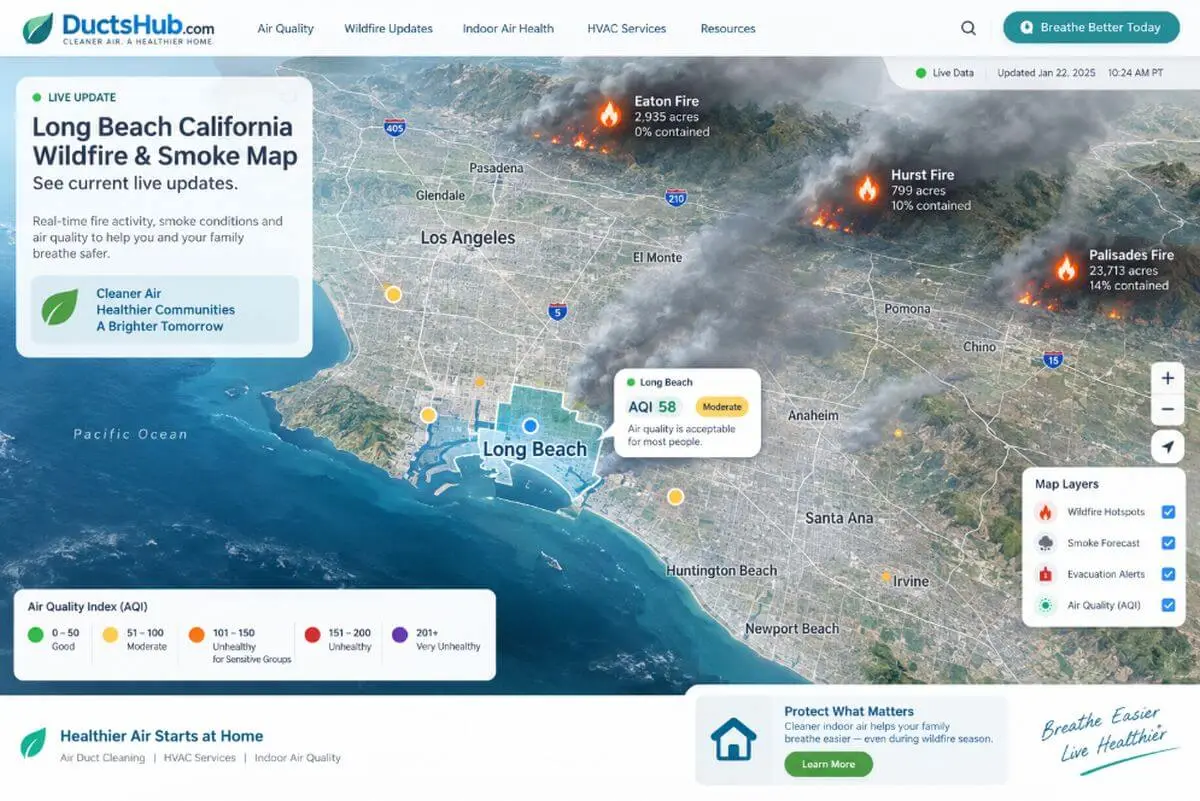
Long Beach residents can track wildfires and smoke today with three free tools used together. A live fire map, such as Filterbuy’s Long Beach wildfire and smoke map, shows active fires and smoke plumes across Los Angeles County and Southern California. The AirNow Fire and Smoke Map shows PM2.5 readings neighborhood by neighborhood. South Coast AQMD advisories forecast when smoke will arrive and how long it will stay. Fire location and smoke location are rarely the same place, so checking all three gives you the full picture.
TL;DR
Long Beach rarely burns, but it often breathes smoke from fires in the San Gabriel Mountains, Orange County canyons, and even the Channel Islands. Check a live fire map for fire locations and the AirNow Fire and Smoke Map for the fine particle reading on your block. When the Air Quality Index (AQI) for fine particulate matter (PM2.5) passes 100, close the house and run your heating, ventilation, and air conditioning (HVAC) fan through a MERV 13 filter.
From the HVAC side: We service HVAC equipment and ductwork across Orange County, directly across the San Gabriel River from Long Beach. After smoke events, the outdoor map clears in a day or two, but indoor smell and gray dust linger because smoke found a path around the filter.
Key Takeaways
- Most Long Beach smoke comes from fires outside city limits.
- The PM2.5 AQI on your block matters more than the distance to the nearest fire.
- The U.S. Environmental Protection Agency (EPA) points to MERV 13 filters for smoke if your system can move air through them.
- If your filter sits in a ceiling or wall return grille, a leak in the duct behind it pulls in air the filter never touches.
- Santa Ana season starts in October, so prepare in September.
Where Can You See a Live Wildfire and Smoke Map for Long Beach Today?
Pair one fire map with one air quality map. A fire map answers “where is it burning,” and an air quality map answers “what am I breathing.” We keep both open during every smoke advisory, because they rarely point to the same place.
Filterbuy is a U.S. air filter manufacturer that publishes free, city-level wildfire and smoke maps. Its Long Beach map layers fire data from the National Interagency Fire Center (NIFC) with smoke plume data from the National Oceanic and Atmospheric Administration (NOAA) Hazard Mapping System, so fires and drifting smoke appear in one view.
What Don’t Live Wildfire and Smoke Maps Tell You?
- A smoke plume on the map may be high in the sky. Satellite outlines, like the NOAA layer on Filterbuy’s map, cannot separate street-level smoke from smoke aloft. Confirm with the nearest PM2.5 sensor.
- A new fire may not be listed yet. CAL FIRE’s incident list covers wildfires of 10 acres or more.
- A green AQI does not rule out ash. South Coast AQMD notes windblown ash can be too large for monitors to detect. If ash lands on your car, treat the air as unhealthy.
- Every map stops at your front door. Indoor air depends on your home’s sealing and filtration.
Why Does Wildfire Smoke Reach Long Beach When the Fire Is Somewhere Else?
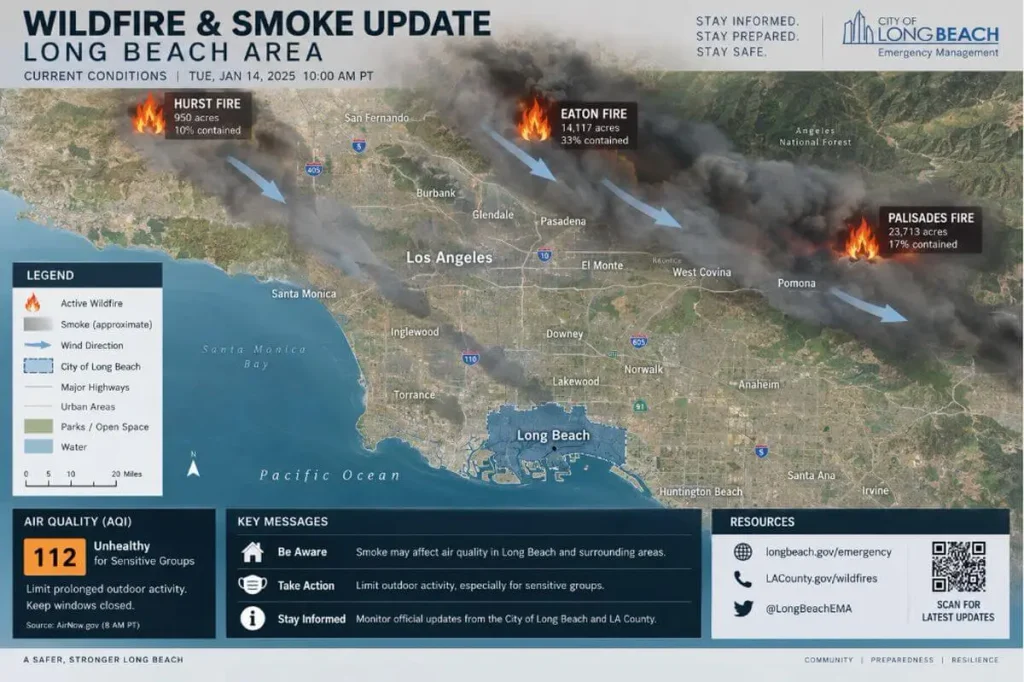
Wind carries it. Cool ocean air usually keeps the city’s air clean, but Santa Ana winds reverse that flow and push smoke from mountain and canyon fires southwest over the Los Angeles basin.
During the January 2025 Palisades, Eaton, and Hurst fires, the Long Beach City Health Officer warned that air quality had already reached potentially unhealthy levels in parts of the city, though none of those fires burned inside city limits.
Smoke also arrives from the water. On May 18, 2026, the South Coast Air Quality Management District (South Coast AQMD) forecast that smoke from the 14,600-acre Santa Rosa Island Fire would come onshore along the entire Los Angeles and Orange County coastline.
Our Orange County wildfire and smoke map and San Bernardino wildfire and smoke guide cover neighboring fire zones.
What AQI Level Means You Should Act in Long Beach?
The AirNow Air Quality Index scale runs from 0 to 500. Each step up in the PM2.5 reading calls for a change inside your home.
| PM2.5 AQI | Category | What We Recommend Inside Your Home |
| 0 to 50 | Good | Normal operation. Check your filter monthly during fire season. |
| 51 to 100 | Moderate | Confirm a MERV 13 filter is installed. Sensitive households close windows. |
| 101 to 150 | Unhealthy for Sensitive Groups | Close windows and fresh-air intakes. Set the HVAC fan to “On.” |
| 151 to 200 | Unhealthy | Run a portable HEPA air cleaner in the bedroom. Turn off swamp coolers and whole-house fans. |
| 201 and above | Very Unhealthy to Hazardous | Stay in the cleanest room and check the filter every few days. |
The Centers for Disease Control and Prevention (CDC) lists people with asthma, chronic obstructive pulmonary disease (COPD), diabetes, chronic kidney disease, or heart disease, along with children and pregnant residents, among those most at risk. Those households should act at the Moderate level.
How Does Wildfire Smoke Get Inside Your HVAC System?
Smoke gets in through open windows, outdoor air intakes, and duct leaks. Duct leaks are hidden, and they are what we find most often when a house still smells like smoke with the windows shut.
In many Southern California homes, the filter sits in a ceiling or hallway return grille instead of at the furnace. Any gap in the return duct between that grille and the air handler, especially in an attic or garage, pulls in air the filter never touches. ENERGY STAR notes that sealing ducts reduces the risk of pollutants entering them and circulating through your home. Our two-minute filter seal check shows how to spot gaps around the filter itself.
Find your filter before the next smoke day:
- Behind a ceiling or wall grille: Check the return duct after it first.
- At the furnace or air handler: Return leaks still reach the filter, so check the filter fit and cabinet seal.
- No filter found: Call a technician. Your system may be running unfiltered.
What Should You Do After the Smoke Clears?
Once outdoor AQI returns to Good or Moderate, air out the house, then follow our post-smoke service call sequence:
- Replace the HVAC filter, even if the intake side looks clean.
- Wipe supply registers and return grilles with a damp cloth.
- Check the filter slot and return plenum for gaps.
- Run the fan for a day and watch for odor or dust at the registers.
- If either remains, book a duct inspection and leakage check.
What Should a Long Beach Home Have Ready Before Smoke Season?
- Two spare MERV 13 filters in your exact size. Filterbuy also makes MERV 13 filters in custom sizes for nonstandard return grilles.
- A portable air cleaner sized to your bedroom. Match its clean air delivery rate (CADR) to the room and check the California Air Resources Board (CARB) list of certified air cleaners. “Mechanical” units produce no ozone.
- Your HVAC fresh-air setting. Learn how to close the intake or switch to recirculate.
- A clean room plan for the most vulnerable person in the house.
“After a smoke week, the filter tells us what came in through the front door, and the return duct tells us what came in through the back. When we pull a clean-looking filter and find gray dust on the return side of the system, the leak is in the ductwork, not the filter choice.”
Essential Resources for Tracking Long Beach Wildfires and Smoke Today
Check the Smoke Reading on Your Street
The AirNow Fire and Smoke Map combines PM2.5 readings from regulatory monitors and low-cost sensors with satellite smoke outlines. It is the fastest way to see the air quality on your block instead of a citywide average.
Confirm Acreage, Containment, and Evacuations
CAL FIRE’s Current Emergency Incidents page is California’s official list of active wildfires of 10 acres or more. Use it when a specific fire is in the news and you need confirmed numbers.
Know When Smoke Will Arrive Before It Does
South Coast AQMD Air Quality Advisories come from the regional air agency for Long Beach. Each smoke advisory forecasts when smoke will arrive and where it will hit hardest, so you can plan tomorrow as well as today.
Spot Fire Danger in the Mountains Upwind of Long Beach
The Angeles National Forest Alerts page posts the current fire danger level and any closure orders for the San Gabriel Mountains. Many fires that send smoke toward Long Beach start there, so a rising danger level is an early warning.
Get Emergency Warnings Sent to Your Phone
Alert Long Beach is the City of Long Beach’s free emergency alert system for wildfires and other emergencies. Warnings arrive by phone or email. Sign up before fire season so warnings reach you without checking a map.
Keep Smoke Out of the Air Inside Your Home
The U.S. EPA Wildfires and Indoor Air Quality guide explains how to use a MERV 13 filter, set your HVAC fan to “On,” close fresh-air intakes, and create a clean room. Every indoor step we recommend during a smoke event matches this guidance.
Research-Backed Numbers Behind Our Long Beach Smoke Advice
1. Wildfires Produce Up to Half of the West’s Fine Particle Pollution
- The finding: Wildfires caused up to 25% of U.S. PM2.5 in recent years and up to half in some Western regions.
- Why it matters in Long Beach: Smoke is a regular part of local air quality.
- Source: NIH PubMed Central: The Changing Risk and Burden of Wildfire in the United States (PNAS, 2021)
2. Wildfire Smoke Raised Respiratory Hospitalizations Up to 10%
- The finding: Each rise of 10 micrograms per cubic meter in wildfire PM2.5 raised respiratory hospitalizations by 1.3% to 10%, compared with 0.67% to 1.3% for other pollution.
- Why it matters in Long Beach: The study covered Southern California’s Santa Ana wind region.
- Source: NOAA Institutional Repository: Wildfire Smoke Impacts Respiratory Health More Than Fine Particles From Other Sources (Nature Communications, 2021)
3. About 20 to 30 Percent of Duct System Air Leaks Out
- The finding: In a typical house, roughly 20 to 30 percent of the air moving through the ducts escapes through leaks and poor connections.
- Why it matters in Long Beach: Return-side gaps pull in unfiltered attic air, so we pair every filter recommendation with a duct check.
- Source: ENERGY STAR: Duct Sealing
Final Thoughts
Most wildfire maps stop at the property line. Our advice doesn’t, because the smoke doesn’t. After years of pulling filters and opening return plenums after smoke events, we follow three rules:
- Read the smoke map, not the fire map. The PM2.5 reading on your block tells you what to do.
- Find your filter before you upgrade it. A MERV 13 with a gap around it performs like a cheaper filter.
- Check the ducts after the sky clears. A lingering smell means smoke found a path around the filter.
We don’t cut corners, we clean them.
Frequently Asked Questions
Where can I see a live wildfire and smoke map for Long Beach?
Filterbuy’s Long Beach map shows fires and smoke plumes on one screen. The AirNow Fire and Smoke Map shows PM2.5 by neighborhood. Use both.
Is there a wildfire near Long Beach right now?
Check a live fire map and CAL FIRE’s incident page, since conditions change hourly. Fires inside city limits are uncommon, but smoke from nearby mountains often reaches the city.
Does my HVAC system help with wildfire smoke if I don’t have central air conditioning?
Yes, if your furnace has a fan-only setting. Set the fan to “On” to move air through a MERV 13 filter.
Should I get my air ducts cleaned after a wildfire smoke event?
Start with a filter change. The EPA recommends duct cleaning only as needed, such as when debris comes out of supply registers.
Check the Map, Then Check Your Ducts
Bookmark the tools above and build your smoke season kit before the next Santa Ana event. If your home still smells like smoke after the air clears, schedule a duct inspection with our team.
Check Smarter. Plan Better. Breathe Easier.
Glossary
- Filterbuy: A U.S. air filter manufacturer that publishes free, city-level wildfire and smoke maps, including a live Long Beach map built on NIFC fire data and NOAA smoke data.
- Filter bypass: Air that moves around an HVAC filter through gaps in the frame, slot, or return duct.